Understanding California’s Tiered Foster Care Rate Structure: What It Means for AFS
California is preparing for a significant change in how foster care funding is determined and delivered. The Tiered Foster Care Rate Structure, commonly referred to as the Tiered Rate Structure or TRS, is designed to base funding on the assessed needs and strengths of each child or young adult, not primarily on the type of placement in which they live.
Enacted through Assembly Bill 161 in 2024, the structure includes three primary funding components: Care and Supervision, Strengths Building, and Immediate Needs. Payments are scheduled to begin on July 1, 2027, or when the required state automation is ready, whichever is later. Implementation also remains subject to a state appropriation. (California Department of Social Services)
Clarifying roles under the new structure
As California prepares for implementation, it is important to distinguish among the organizations that will have responsibilities under the new system.
The enacted law and current California Department of Social Services guidance do not establish one umbrella “Qualified Entity” that receives, manages, and distributes all three funding components. Instead, responsibility is divided among several partners.
Placing agencies, county child welfare agencies, county probation departments, and eligible Tribes with state agreements, will be responsible for ensuring that assessments are completed, coordinating case planning, and administering the Immediate Needs Program.
Caregivers and foster care providers will receive the Care and Supervision component. When a child or young adult is placed through a Foster Family Agency such as AFS, the payment will flow through the FFA and include an additional Provider Administrative Rate.
A CDSS-contracted Financial Management Coordinator, referred to as a spending plan manager in the statute, will help children, families, and young adults manage Strengths Building Funding according to an individualized spending plan.
Immediate Needs services will be provided either by a placing agency that has received CDSS certification or by a certified provider contracted by the placing agency. FFAs may pursue certification to serve in that provider role. (California Department of Social Services)
How a young person’s tier will be determined
The Integrated Practice–Child and Adolescent Needs and Strengths assessment, or IP-CANS, will serve as the functional basis for assigning a child or young adult to the appropriate funding tier.
The IP-CANS is designed to identify both needs and strengths. It is intended to be completed as part of a person-centered, consensus-based process informed by the Child and Family Team. That team may include the child or young adult, family members, caregivers, caseworkers, behavioral health professionals, service providers, natural supports, and Tribal representatives when applicable.
The placing agency is responsible for ensuring completion of the IP-CANS. Once a tier has been determined, the core tier generally follows the child or young adult across most placement changes. A Provider Administrative Rate may be added or removed depending on whether the placement is through an FFA, Community Treatment Facility, or Short-Term Residential Therapeutic Program. (California Department of Social Services)
How support is designed to flow
Each component of the Tiered Rate Structure has a different purpose and administrative process:
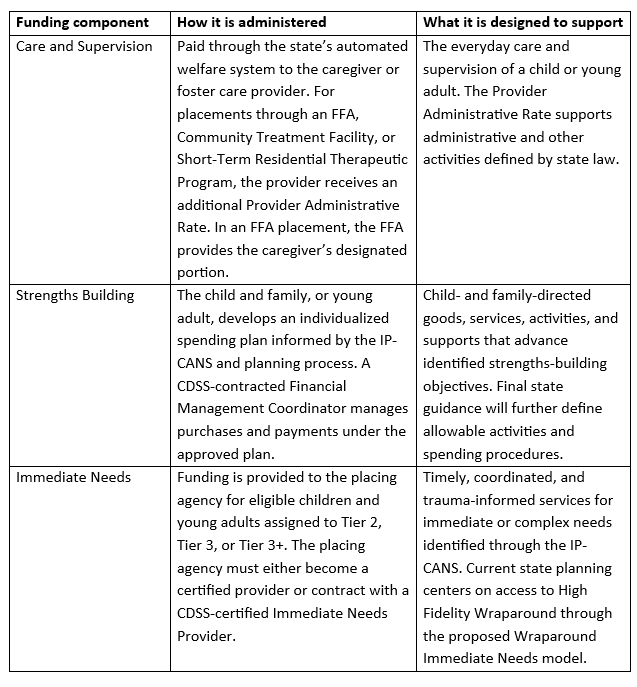
This structure means that not all funding will be paid directly to a caregiver or FFA. In particular, Strengths Building Funding will be managed through an individualized spending plan, while Immediate Needs Funding will support coordinated service delivery through placing agencies and certified providers. CDSS is still developing detailed program guidance for these components. (California Department of Social Services)
This table provides a general overview. Different requirements apply to certain settings and permanency programs, including Supervised Independent Living Placements, Transitional Housing Placement programs, the Adoption Assistance Program, and Kinship Guardianship Assistance Payments. (California Department of Social Services)
Why the change matters
California’s current foster care rate structure uses different funding approaches for home-based and residential placement settings. The Tiered Rate Structure is intended to create a more individualized connection between a young person’s assessed needs, identified strengths, and available resources.
For children, youth, young adults, and families, the new structure is intended to provide:
- A more consistent assessment and planning process centered on the IP-CANS and Child and Family Team.
- Core funding that generally follows the young person across placement settings.
- Greater participation by children, families, and young adults in identifying strengths-building goals and selecting appropriate supports.
- Dedicated resources for positive activities and experiences that may fall outside traditional Care and Supervision payments.
- More coordinated services for young people with higher or more immediate needs.
The structure does not replace thoughtful case planning, clinical judgment, or collaboration. Instead, it is designed to give teams a broader set of resources with which to respond to each young person’s circumstances. (California Department of Social Services)
What this means for AFS
As a Foster Family Agency, AFS will have an important—but specific—role under the new structure.
For children and young adults placed through AFS, the Care and Supervision payment and applicable Provider Administrative Rate will flow through the agency. AFS will then provide the resource parent’s designated portion of the payment. AFS staff will also continue to collaborate with placing agencies, caregivers, children, families, behavioral health providers, and other Child and Family Team members around assessment, planning, and service coordination.
Strengths Building Funding will not become an unrestricted AFS program budget. The child and family or young adult will help determine how the funding is used, and the state-contracted Financial Management Coordinator will manage approved purchases and payments.
An FFA may also become a certified Immediate Needs Provider. If AFS pursues and receives that certification, placing agencies could contract with AFS to provide Immediate Needs services for eligible young people placed through the agency. Any such role will depend on final CDSS standards, the certification process, organizational readiness, and county agreements. (California Department of Social Services)
AFS is closely monitoring implementation and preparing for the ways the new structure may affect our programs, staff, resource parents, clinical teams, administrative systems, and county partnerships. Our focus remains on helping translate policy and funding into coordinated, individualized support for children, youth, and families.
Implementation is still evolving
CDSS entered the early implementation phase in July 2026 and continues to develop operational guidance. The department expects to release additional Strengths Building guidance, including a standards-of-care framework and examples of allowable activities, later in 2026. Spending-plan procedures and conflict-resolution guidance are also still in development.
The proposed Wraparound Immediate Needs model is similarly evolving. CDSS and the California Department of Health Care Services are gathering feedback on how Immediate Needs Funding and High Fidelity Wraparound services should work together. Because these details have not been finalized, some processes and responsibilities may change before implementation. (California Department of Social Services)
Although the funding framework is changing, AFS’s commitment remains consistent: supporting children, youth, and families with services that recognize their strengths, respond to their needs, strengthen important relationships, and contribute to their safety and wellbeing.
AFS will continue to share updates as California releases additional guidance and moves closer to implementation.
